
What is a Cultivation Trough?
Characteristics and Applications of Vertical Soilless Cultivation Troughs
- Core Definition & Essential Function of Cultivation Troughs
- Core Classification: Materials and Types Determine Application Scenarios
- Core Advantages of Cultivation Troughs: Empowering Modern Agriculture
- Wide Application Scenarios of Cultivation Troughs
- Future Outlook & Sustainable Agriculture
- Frequently Asked Questions (FAQ)
- Need Help Choosing the Right Cultivation Trough?
With the rapid iteration of global protected agriculture and soilless cultivation technology, cultivation troughs, as core planting facilities, are gradually replacing traditional soil planting models and becoming the preferred equipment for greenhouses, agritourism, urban gardening and other scenarios. coldrollforming.com is deeply engaged in the field of protected agricultural equipment, providing one-stop cultivation trough and soilless cultivation solutions, as well as professional technical guidance for growers around the world. It not only reshapes the spatial form of crop growth, but also promotes the transformation of agricultural production towards high efficiency, standardization and greenization.
1. Core Definition and Essential Function of Cultivation Troughs
A cultivation trough is a structured planting facility used to support planting substrates, fix crop roots, and be equipped with irrigation and nutrient solution recovery systems. Its core function is to isolate surface soil and create a controllable root growth environment for crops. Different from traditional soil planting, cultivation troughs use artificially configured substrates (such as coco coir, rock wool, peat, etc.) to replace soil, and are combined with precise water and fertilizer systems to achieve refined regulation of water, nutrients and air permeability, fundamentally solving agricultural pain points such as soil-borne diseases, continuous cropping obstacles and soil salinization.
As the core carrier of soilless cultivation systems, cultivation troughs not only provide stable growth support for crops, but also guide the efficient recovery and reuse of excess nutrient solution, which reduces resource waste and minimizes environmental pollution. They are the key link between planting carriers and intelligent management in modern agricultural production.
2. Core Classification: Materials and Types Determine Application Scenarios
(I) Classification by Material: Adapting to Different Planting Needs
The material of the cultivation trough directly affects its service life, corrosion resistance and applicable scenarios. Currently, the mainstream materials are mainly divided into two categories:
🔩 Steel Cultivation Troughs
Mostly made of 0.6-0.8mm thick double-sided galvanized steel processed by a rollforming machine, with a non-toxic polyester coating. Advantages: corrosion resistance, high toughness, long service life (10-15 years). Seamless design prevents nutrient solution leakage, suitable for large-scale production in multi-span greenhouses. First choice for large-scale protected agriculture.
🧪 Polypropylene (PP)/PVC Cultivation Troughs
PP troughs (0.7-1.0mm thick): stable chemical properties, non-toxicity, corrosion resistance and relatively low cost. PVC troughs: flexible shaping, excellent UV resistance and acid-alkali resistance. Suitable for temporary exhibitions, home gardening, scientific research experiments. Some have water leakage risk at joints, ideal for small and medium-sized planting projects.
In addition, there are cultivation troughs made of foam, resin and other materials, mostly used in agritourism and vertical greening, combining portability and aesthetics.
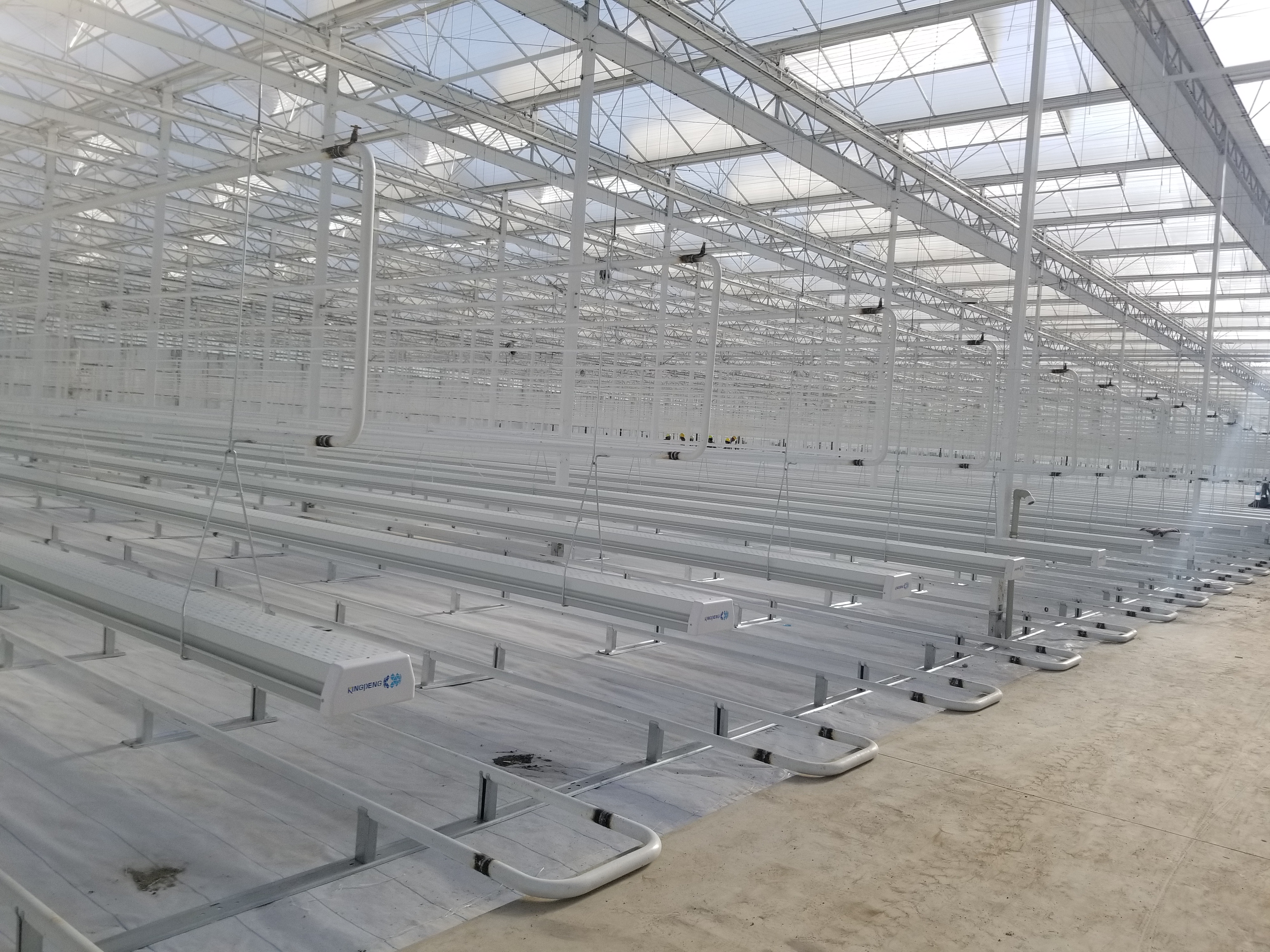
(II) Classification by Installation and Structure Type: Unlocking Vertical Planting Space
Horizontal Cultivation Troughs: Including ground-supported and underground types, easy to install and low cost. The underground type is excavated on the ground, lined with black and white film and wire mesh, filled with coco coir substrate, and equipped with an automatic irrigation system — effectively avoids soil-borne diseases, suitable for high-efficiency protected agricultural production and soil improvement projects.
Vertical Cultivation Troughs: As the mainstream form of efficient space utilization, common types include A-frame, H-frame multi-layer, trailing vine, pagoda and column types. For example, A-frame cultivation troughs adopt square steel welded brackets, matched with trapezoidal planting troughs or PVC pipes, movable and easy to operate, suitable for leafy vegetables, strawberries and some flowers; adjustable vertical cultivation troughs use the lever principle to adjust height according to light, maximizing photosynthetic efficiency — ideal for vertical farms, research and study education.
3. Core Advantages of Cultivation Troughs: Empowering the Upgrade of Modern Agriculture
Compared with traditional soil planting, cultivation troughs show multiple irreplaceable advantages due to their unique structural and functional design:
Crop roots are completely isolated from soil, fundamentally eliminating the spread of soil-borne diseases, solving continuous cropping obstacles and soil salinization, without frequent soil replacement, reducing planting risks.
The supporting closed irrigation system can realize precise delivery and recycling of nutrient solution, with water and fertilizer utilization rate increased by more than 30% compared with traditional planting. Digital monitoring and refined regulation.
The vertical structure design breaks the limitation of horizontal planting, and the yield per unit area can be increased by 2-5 times, especially suitable for greenhouses, urban balconies and agritourism parks.
The installation height can be adjusted according to the grower's height, and automatic equipment reduces manual operations (vine tying, lowering, weeding). Unified planting environment makes crops grow neatly, facilitating standardized harvesting.
📊 Quick Comparison: Steel vs. PP Cultivation Troughs
| Feature | Steel Troughs | PP/PVC Troughs |
|---|---|---|
| Service Life | 10–15 years | 3–7 years (depends on UV exposure) |
| Load Capacity | High (supports heavy substrates & crops) | Medium, suitable for lightweight greens |
| Installation & Leakage | Seamless, no leakage | Joints may leak, requires careful sealing |
| Best Use | Commercial scale, multi-span greenhouses | Home gardening, R&D, temporary projects |
4. Wide Application Scenarios of Cultivation Troughs
Today, cultivation troughs have penetrated into many fields such as agricultural production, landscape greening and popular science education: in protected agriculture, they are used for large-scale production of fruit vegetables, leafy vegetables and medicinal plants; in agritourism parks and ecological restaurants, vertical landscapes are created through pagoda-shaped and wall-mounted cultivation troughs, combining ornamental and practical values; in urban spaces, small cultivation troughs can be built on balconies and roofs to realize home gardening and urban greening; in the field of scientific research and study, their controllable growth environment has become an ideal carrier for crop cultivation and agricultural technology promotion.

5. Future Outlook & Sustainable Agriculture
With the global popularization of soilless cultivation technology and policy support, cultivation troughs are developing towards more environmentally friendly materials, more intelligent structures and more affordable costs. coldrollforming.com focuses on the customization and promotion of cultivation troughs, relying on advanced rollforming machine technology to accurately process various steel cultivation troughs, and can provide highly adaptable personalized solutions according to the planting needs of different countries and scenarios. Whether it is a large-scale agricultural production base or a niche gardening project, cultivation troughs, with their flexible adaptability and high efficiency, have become an important bridge connecting traditional agriculture and modern agriculture, injecting strong impetus into the sustainable development of global green agriculture.
11. Frequently Asked Questions
12. Conclusion
Cultivation troughs represent a fundamental shift from traditional soil farming to precision soilless agriculture. Whether you choose durable steel troughs for large-scale commercial production or cost-effective PP/PVC systems for smaller projects, the benefits of vertical space utilization, water efficiency, and disease control are undeniable. coldrollforming.com provides end-to-end solutions tailored to your specific crop and greenhouse requirements, ensuring you get the right configuration for sustainable, high-yield farming.
📞 Need Help Choosing the Right Cultivation Trough?
Not sure whether steel or PP cultivation trough fits your greenhouse project? Looking for a customized vertical soilless system for leafy greens, strawberries or medicinal plants?
Contact us with your:
- Greenhouse dimensions & crop types (tomatoes, lettuce, strawberries etc.)
- Expected planting scale & substrate preference (coco coir, rock wool)
- Budget and space constraints


